


Ask Claude or ChatGPT to recommend a business in your industry.
Does your company come up?
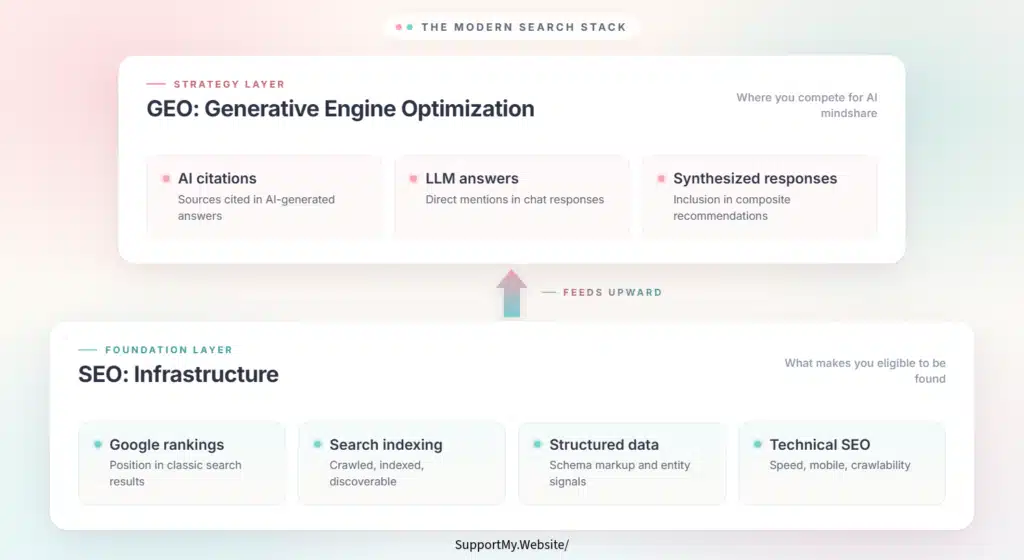
If not, you're seeing the practical effect of a shift that's already underway. The GEO vs SEO conversation isn't really an either-or. Search has moved up a layer, and most businesses are still optimizing for the layer below. Generative Engine Optimization (GEO) is the new strategic layer. SEO is what it's built on. This article walks through how the two relate, what the difference means for your business, and what to actually do about it. GEO is also known as Answer Engine Optimization, "AEO".
Key takeaways
- GEO vs SEO is not an either-or. GEO is the new top layer of search. SEO is the infrastructure underneath. You need both.
- AI Overviews have cut click-through rates on top-ranking Google content by 58% compared to a December 2023 baseline (Ahrefs, February 2026). Ranking #1 is no longer enough to capture traffic.
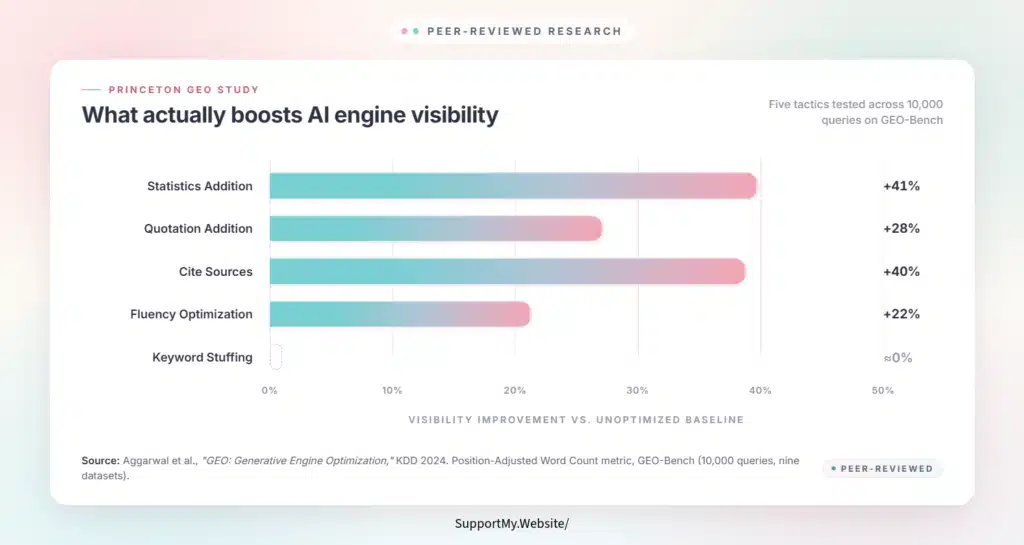
- The highest-impact GEO tactics come from peer-reviewed research. The Princeton-led GEO study (Aggarwal et al., KDD 2024) found that adding statistics, quotations, and citations to your content each boost AI engine visibility by up to 40%.
- For small businesses, the work is recurring website hygiene: clean structured data, current content, fast and indexable pages.
- Quick diagnostic: ask ChatGPT or Claude to recommend a business in your category. If you're not in the answer, that's the work in front of you.
How is generative AI changing search in 2026?
For about two decades, SEO has been the dominant strategic layer. You optimize for Google's ranking algorithm. Google sends you traffic. You convert that traffic on your site. That was the whole stack.
GEO is the new layer on top. It's the practice of structuring your content and digital presence so that LLMs (ChatGPT, Claude, Perplexity, Gemini, and Google's own AI Overviews) cite you when they generate answers. The user never sees ten blue links. They see a synthesized response, and your business is either inside that response or it isn't.
SEO didn't go away. It got demoted to infrastructure.
LLMs still pull heavily from search indexes. Writesonic's analysis of more than a million AI Overviews found that over 40% of citations came from Google's top 10 results. If you don't rank, you're unlikely to be cited. But ranking on its own is no longer enough. Ahrefs reported in February 2026 that AI Overviews cut click-through rates for top-ranking Google content by 58% compared to a pre-AI-Overviews baseline (December 2023 versus December 2025). You can rank #1 and still lose the click.
The implication is simple. SEO gets you eligible. GEO gets you chosen.
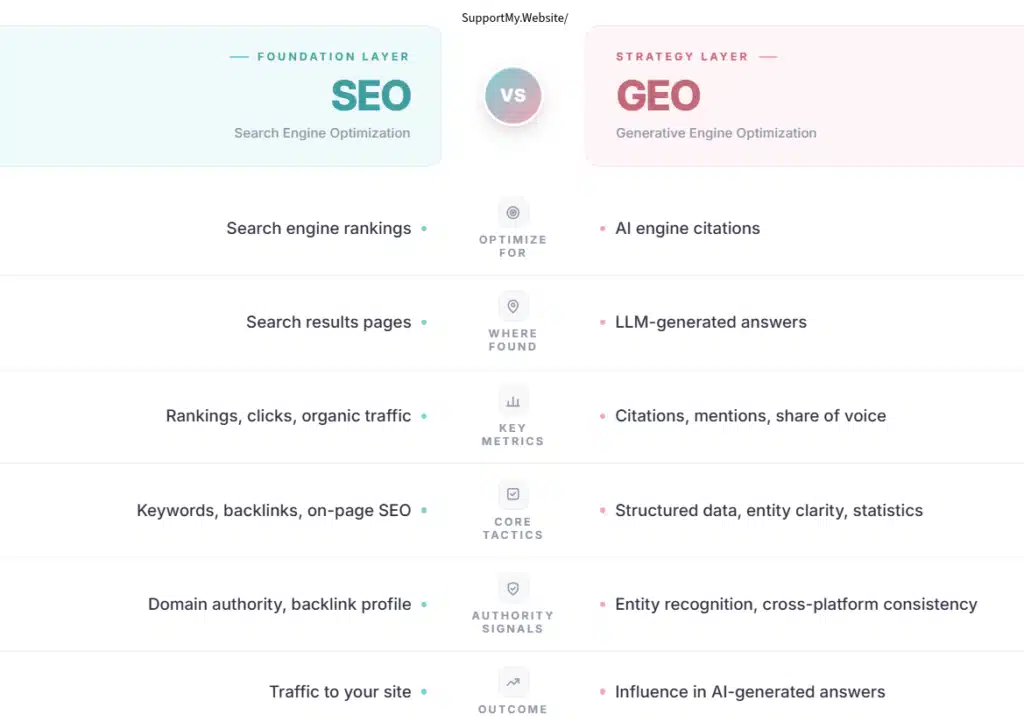
The Core Differences: SEO vs GEO at a Glance
| Aspect | SEO | GEO |
|---|---|---|
| What you optimize for | Search engine rankings | AI engine citations |
| Where your business appears | Search results pages | LLM-generated answers |
| Key metrics | Rankings, clicks, organic traffic | Citations, mentions, share of voice in AI responses |
| Core tactics | Keywords, backlinks, on-page SEO | Structured data, entity clarity, statistics and citations in content |
| Authority signals | Domain authority, backlink profile | Entity recognition, cross-platform consistency |
| Outcome | Traffic to your site | Influence in synthesized AI answers |
The two are not interchangeable, and neither replaces the other. SEO gets you eligible. GEO gets you chosen.
Why are small businesses behind on GEO?
Small businesses sit in a difficult spot on this shift. They typically have less domain authority than the incumbents in their category, fewer backlinks, and less budget to throw at SEO. That worked when ranking was the goal. It works less well now.
AI Overviews are eating clicks regardless of who ranks. Even when a small business wins the keyword fight, the click often doesn't follow. LLMs weight authority signals when deciding what to cite, which means a small business can rank for a long-tail query and still not get mentioned in the AI's answer. The traffic that used to follow a #1 result is increasingly going to the model itself.
That's the obstacle side. There's an opportunity side, and it's the part most people miss.
GEO rewards content structure, entity clarity, and machine-readable signals. These aren't as bound to backlink history as classical ranking is. A small business with clean schema, structured data, and clearly written content can show up in AI answers even when its Google ranking is middling. That's closer to a level playing field than backlink-driven SEO has ever offered smaller players.
The window is open. Businesses that adapt to the GEO layer now will show up in AI answers ahead of larger competitors who haven't done the work. The ones that ignored basic website hygiene for years are about to fall further behind.
At Support My Website, we maintain websites for small businesses, professional services firms, and regional organizations. Across that client base, we see this play out consistently. The businesses that ranked well in 2022 and stopped maintaining their sites have lost ground in AI answers. The ones that stuck with regular content and schema updates have held visibility even when their Google rankings haven't changed much. The maintenance work was paying off in the old search stack and pays off again in the new one.
Here's a useful illustration. Pick a category in your own city you know cold, the actual best three coffee shops, the best three accountants, whatever you know better than the algorithm. Ask ChatGPT to name the top three. The mismatch you see is the same mismatch every business in your category is dealing with at the GEO layer. The list is being generated, not retrieved. The businesses that show up are the ones whose data is structured enough for the model to confidently reference them.
What should small businesses do to optimize for AI search?
The work itself is less dramatic than the framing suggests. Most of it is website hygiene that's mattered for years, with sharper consequences now that LLMs are doing the synthesizing.
The work breaks down into four ongoing areas:
Structured data maintenance. Schema markup needs to stay current as Google's supported types change. The company deprecated FAQ rich results in May 2026 after restricting them since 2023, and that kind of churn is normal. New pages need new markup. Existing markup needs review when schema types change.
Content maintenance. Pages need updates, not stagnation. AI models tend to discount content that signals abandonment, and outdated content drifts out of citation patterns over time.
Technical hygiene. Sites need to stay fast, indexable, and free of issues that make AI crawlers give up partway through. This is the same work that's mattered for traditional SEO. The consequences are now sharper.
Listing consistency. For businesses with physical locations, your business details across directories and listings need to stay consistent. For digital-only businesses, this matters less, though entity-recognition signals (consistent company description across platforms) still help.
How content writing changes for GEO
The writing matters more than it used to. The strongest peer-reviewed research on what actually gets cited by AI engines (the Princeton-led GEO study, published at KDD 2024) tested specific tactics against a 10,000-query benchmark.
The three highest-impact tactics from the Princeton study:
- Add relevant statistics. Real numbers from real sources, attributed to those sources. Specific data beats generalization.
- Quote credible sources. Authoritative voices, not paraphrases. AI engines extract direct quotes with high confidence.
- Cite reliable references inline. Research papers, government data, industry reports. Citations signal that your content is built on something rather than asserted.
Each of these tactics improved AI citation rates by up to 40% in the Princeton study. Fluency and readability improvements helped too, in the 15 to 30% range. Old keyword stuffing didn't help at all.
The practical translation: write with specifics. Real numbers, real quotes from real sources, real citations. A sentence like "Acme Tax Group filed returns for 2,400 clients in the 2024 season" gets extracted into an AI answer. "Leading provider of tax services" doesn't, because there's nothing for the model to pull. Generic corporate phrasing is invisible at the GEO layer.
How off-page signals shape AI citations
The Princeton tactics cover what's inside your content. The off-page side of GEO matters too, and it's where the "SEO as infrastructure" point gets concrete.
When an LLM is asked to recommend a business in a category, it leans heavily on what other authoritative sources say about you. Being included in third-party "top 10" lists, industry roundups, and credible review sites is one of the strongest signals you can earn. So is being linked from sites that themselves rank well, since LLMs disproportionately cite from Google's top 10.
None of this is new. Earning quality mentions and high-authority backlinks has been the work for two decades. The shift is that the same investment now pays off twice: in the SEO layer where it always did, and in the GEO layer where LLMs use the same signals to decide who to cite.
What does GEO optimization actually look like in practice?
Here's the part that's easy to miss in the AI-search hype: the businesses showing up in LLM-generated answers are mostly the same ones that have already been doing foundational SEO and website maintenance work. Clean structured data. Maintained content. Updated listings. Fast, indexable websites.
Support My Website has been doing this work for clients since 2019. The pattern we see consistently: the businesses that show up in AI answers are the ones that already have the basics dialed in. Our team handles structured data maintenance, content updates, and technical hygiene for a range of clients including regional accounting firms, financial services groups, and professional services organizations. Most of them weren't thinking about GEO when they signed up. They're benefiting from it now because the underlying work overlaps almost completely with the SEO and security maintenance they were already paying for.
How do you measure GEO performance?
Traditional SEO has rankings and clicks. GEO is harder to measure but not impossible. Three practical tracking approaches:
Manual AI prompting. Run the same set of queries against ChatGPT, Claude, and Perplexity on a monthly schedule. Track whether your business appears in the answers for the queries that matter to you. Tedious but free, and it captures what's actually happening at the user-facing layer.
AI mention tools. Ahrefs Brand Radar and similar tools track brand mentions across AI engines at scale. Useful if you have the budget and the volume to justify the spend.
Referral traffic. Watch your analytics for visits originating from AI domains (chatgpt.com, perplexity.ai, copilot.microsoft.com). The volume is currently small but growing, and the trend matters more than the absolute numbers.
The shift isn't from "old work" to "new work." It's from one-time SEO setup to ongoing maintenance discipline. The same checklist that produced a well-ranking site in 2022 produces a well-cited site in 2026, as long as you keep doing it.
Why isn't my business showing up in ChatGPT or AI Overviews?
If you ran the test at the top of this post and your business didn't appear, the reason is almost always the same. The foundational work hasn't been done yet, or it was done once and not maintained. AI engines don't penalize you for being small. They synthesize from what they can confidently extract. If your structured data is incomplete, your content is stale, or your entity signals are scattered across platforms, you're not in the answer because there isn't enough for the model to pull.
The fix isn't speculative, and it isn't urgent in a panicked way. It's a list of practical website and presence work, most of which has been overdue for years.
The shift from SEO as the top layer to SEO as infrastructure is already happening. The businesses that recognize it early get a window of advantage. The ones that don't will spend the next few years wondering why their rankings stopped translating into customers the way they used to.
Frequently asked questions about GEO
What is Generative Engine Optimization (GEO)?
GEO is the practice of structuring content and digital presence so that AI engines (ChatGPT, Claude, Perplexity, Gemini, Google AI Overviews) cite your business when generating answers. It sits above traditional SEO in the search stack, with SEO functioning as the underlying infrastructure.
Is SEO dead?
No. SEO is now the infrastructure layer that GEO depends on. LLMs still pull heavily from search indexes. Writesonic's analysis found more than 40% of AI Overview citations come from Google's top 10 results. Without SEO, you don't get cited. With only SEO, you're missing the new top layer.
What's the practical difference between GEO and SEO?
SEO optimizes to rank in search results. GEO optimizes to be cited inside AI-generated answers. SEO measures rankings and clicks. GEO measures citations and mentions in AI responses. The two work together: SEO gets your content into the search index that AI engines pull from, and GEO determines whether the AI engine selects your content for its answer.
What's the highest-impact GEO move for a small business?
Peer-reviewed research from Princeton (Aggarwal et al., KDD 2024) found three tactics that each improve AI citation rates by up to 40%: adding relevant statistics, quoting credible sources, and citing reliable references inside your content. These changes are practical, don't require backlinks, and apply to any business publishing content.
How long does it take to implement GEO?
The foundational technical work (clean schema, structured data, conversational content) is typically several weeks of focused work followed by ongoing maintenance. There's no one-time "done" state because the underlying rules (supported schema types, AI engine ranking factors) keep changing.
Do I need to remove FAQ schema after Google deprecated rich results?
No. Google has stated it still uses FAQ structured data to understand pages, and some practitioner data suggests pages with FAQ schema continue to appear in AI Overviews. The visible search result feature is gone but the underlying signal still has value for AI citation purposes.
Can I do GEO myself or do I need help?
Both are possible. The work is technical website maintenance, content management, and structured data hygiene. Businesses with in-house developers and content teams can do this themselves. Businesses without that capacity typically work with website maintenance services like Support My Website.
Where to go from here
If your test at the top of this post didn't return your business, the work in front of you is concrete: structured data, content maintenance, technical hygiene, and content that includes the kinds of statistics and citations AI engines extract. Support My Website handles this kind of ongoing work for small businesses, professional services firms, and regional organizations. If you want to talk about whether it's a fit for your business, get in touch.