

strategy
Aim your content at traffic that actually buys.
Keyword research, competitor analysis, content gap mapping, and keyword scaffolding so the SEO work you ship goes after the searches that turn into real revenue, not vanity rankings.
01 / Why it matters
Ranking #1 for the wrong keyword still gets you zero leads.
Most SEO advice tells you to rank for the highest-volume keywords in your category. That advice is wrong. High-volume usually means high-competition, generic intent, and visitors who were not going to buy anyway. You can rank number one for a 20,000-search-a-month keyword and still get zero leads from it.
The keywords that actually drive revenue are usually smaller, more specific, and tied to buyer intent. Most teams don’t find them because finding them takes a real research project, not a pull from a keyword tool. So they end up either chasing high-volume keywords that don’t convert, or publishing content based on a hunch about what their audience cares about.
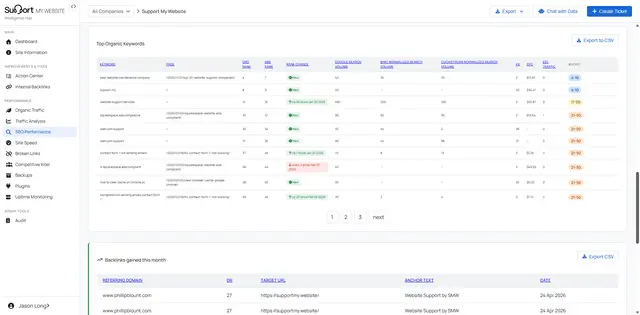
Every keyword you rank for, with movement over time, available the moment you have a question inside your portal.
02 / What it does
A research project, a keyword scaffold, and a content roadmap. Then we hand it to execution.
We run a real research project before anyone writes a word. We look at what your existing customers searched to find you, what your competitors are ranking for that you aren’t (via Ahrefs and Search Console), what the search results actually look like for the queries that matter, and which terms have buyer intent versus just informational intent.
The output is a keyword scaffold (clusters mapped to page topics) plus a content roadmap that becomes the upstream input to SEO and content execution. Existing pages are audited too: which of your current pages have unrealized ranking potential and need a refresh rather than a new article.
03 / How it helps
You stop publishing on a whim and start ranking for terms that bring buyers.
You stop publishing blog posts on a whim. The content calendar maps to a researched list of keywords with real buyer intent, prioritized by traffic potential and competitive difficulty. Within two to three months, you start seeing ranking improvements on the terms that bring qualified leads, not just impressions.
For most clients, the research turns up between one and three existing pages that were eighty percent of the way to ranking for a valuable query but missing one or two specific things. Fixing those first usually produces traffic and leads weeks before any new content even ships.
04 / Specifics
What’s in the engagement
- Keyword research grounded in your actual customer search behavior, not generic industry lists
- Competitor analysis via Ahrefs: who is ranking for what, with what kind of content
- Content gap analysis: searches your competitors capture and you do not
- Search intent mapping (informational vs comparison vs purchase) so the content matches the searcher’s stage
- Keyword scaffolding: clusters mapped to page topics so the content roadmap has structure, not just a list
- Existing-page audit: which of your current pages have unrealized ranking potential and just need a refresh
- Prioritized content roadmap with target keywords, content type, and effort estimate per item, ready to hand to SEO & content execution
Want the keyword research project most teams skip?
Book a discovery call. We will explain the research process and show you the kind of content roadmap it produces.